
In today’s episode, I provide a few life updates and then shares a wonderful planning tip from a listener.
Then, topics discussed include:
- Does planning help to save money?
- How do you avoid rewriting daily lists when things don’t get done?
- What are some analog ways to track workouts?
- Ideas for using monthly spreads of paper planners if you don’t feel the need for an extra calendar
- New pen in town: The Pilot Juice+
Link to task management ep mentioned is here!
Current new fave pen:
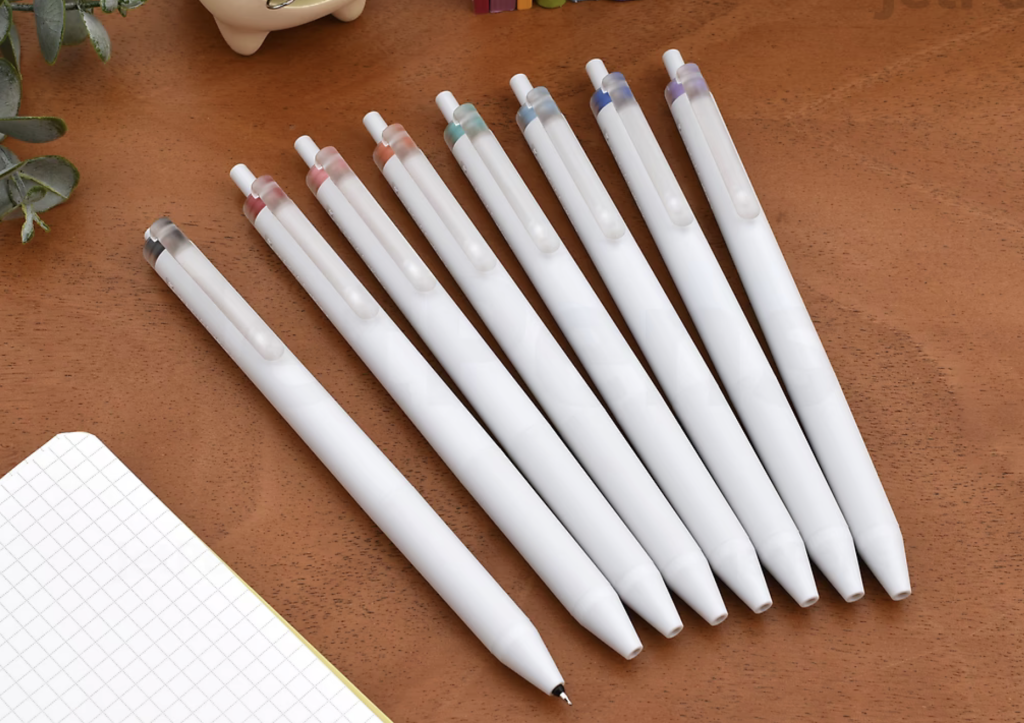
(They are currently out of stock in black and multi-packs! Pretty sure my episode mention didn’t cause this pen-buying frenzy; it’s just a great pen!)

10 Comments
IDK planning kind of cost me money this year bc I made plans and now need surgery, so plans had to be cancelled. Fortunately, everything was mostly fully refundable, but YMMV. 🙂
I find that planning often costs me money too bc I think of fun / expensive things I want to do! (So that was kind of my take, but I absolutely see how planning *could* save you money if that was the aim . . .)
Maybe planning makes me more ok with spending money to do fun things? I know I have a huge hangup about doing this… but spending money on fun experiences can be positive to, even if it $$$$.
yes totally! I definitely didn’t mean to imply this spending was a negative. I definitely choose to do plenty of it personally (and one benefit of doing it ahead is you get the anticipatory benefit, too). I’m glad you are feeling more okay with it lately!!!
It’s so funny, Sarah, we’re like opposites on what we track digitally vs analog! As you know I’m a big digital planner and track most habits etc digitally too.
But for workouts, I’m primarily ANALOG! (This is mostly for my strength workouts at the gym.) The reason I track workouts analog is because I don’t like having to open and close my phone constantly while I’m working out. I prefer to put my phone away and have it be mostly unplugged/podcast listening time.
I buy a notebook (medium sized, not tiny). I then create a separate page for each workout of the week. This one page will last the whole month. (I do the same workouts for about a month and then switch programs.) I then write each exercise, and below it, I list weeks 1-4 with blank space, for the 4 weeks of a month, along with the prescribed reps and sets I’m going to do.
Then as I do the workout, I just fill in what I did. This allows me to so easily look back at the previous week the next time I do it, with zero flipping around.
For example, it would look like this:
Page 1, Monday: April 2026 Legs #1
A. Dumbbell Thrusters: 4 sets x 10 reps
1. 4/6: (20# 10 r) (20# 10r) (20# 10r) (20#10r) -> not too hard, increase next week!
2. 4/13: (25# 10r) (25# 8 r) (25# 8r) (25# 8r)
3. 4/20:
4. 4/27:
B. Dumbbell Bulgarian Split Squats: 4 sets x 10 reps
1. 4/6: (25# 10r) (25 # 10r) etc .etc.
2.
3.
4.
C. Machine Calf Raises: 4 sets x 15 reps
1.
2.
3.
4.
Etc- finish listing whole workout.
There’s a tiny bit of “start up” time where at the beginning of the month I have to write out the blank template, but then I just fill it out as I do the workout, by hand.
I don’t currently track cardio this way, but if I were into running or something, I’d probably just make a page for each day of the week and do the same thing for my cardio! Like:
Page 2, Tuesday:
1. 4/7: Ran 3.5 miles at 9:10 pace at 0630, felt good!
2. 4/13: 5 miles at 9:30. Rainy and felt tired.
3.
4.
Page 3, Wednesday- Chest/ Tris:
A. Dumbbell Bench Press 4 sets x 8 reps
1. 4/7:
2. 4/13:
3. 4/20:
4. 4/27:
B. Tricep Extensions 4 sets x 12 reps
etc.
In total this eats up like, max of 7 pages in a notebook per month? (For me only 3-4 since I don’t track cardio here.) I LOVE doing this analog and people sometimes come up to me and comment on me writing diligently in my little notebook at the gym. haha. 🙂 I once had a teenager approach me very intrigued by what I was writing in my notebook! 😅 I have a bunch of these notebooks saved going back like, 10 years! lol.
I actually think you sold planning *short* in your answer about whether it saves you money if you care about experiences! While I completely agree with you that if you want to have experiences, they usually involve spending some money, the alternative is sitting at home and doing nothing. So then an apples-to-apples comparison would be (a) doing the experience having planned for it in advance vs (b) not planning for the experience and then figuring out a way to do it anyway — which may sometimes (often?) cost more.
A very concrete example from my own life — I attend several concerts every year at San Francisco Symphony, and tend to buy most (if not all) of my tickets early on when the “compose your own” subscriptions become available (you have to buy tickets to at least 3 concerts which I would do anyway). This way, I only go to see what I want to see, get the tickets at the original price sold by the venue, and perhaps even receive a small discount for buying several at once in this manner. A very good front row(s) and center balcony ticket can be as low as $60 and as “high” as ~$120 (for some very special guest artists), and fancy “loge” tickets cost ~$200. I’ve never *not* been able to get tickets to whatever concert I wanted when buying tickets for next season.
A friend was telling me that she couldn’t get tickets to a specific concert she wanted to see for less than $600-$850, which seemed totally crazy. As we kept discussing and I later checked online, she wanted to go to a concert with a world-famous guest artist that was happening only 2 months out from our conversation — by that point, the concert was “sold out” on the SFS website, so presumably she was looking at Stubhub, etc. When I mentioned to her that I was currently buying tickets for *next* season (for another artists she cared about seeing) for a fraction of what she was quoting, she said she didn’t want to commit to buying tickets that far into the future.
Which is a totally valid response! But I’d argue that in this case planning DOES save you a lot of money ($1000+ for 2 tickets!). Yes, not going at all saves you even more, but then it feels like you are really mixing apples and oranges.
P.S. And yes, I understand that life happens and you could end up not going at all, there could be sales closer to the date that could have allowed you to spend even less, etc., etc. All in all though, I believe doing this year after year definitely saves me money in the long run while still going to see the performances I care about (vs missing out altogether).
ooh i LOVE THIS! Thank you for this perspective!!!
I 100% think planning saves me money!!! I’m always looking for a deal.
Here in Europe, I’m leaning into free museum days (in the long run it can save a lot of money), and I only know about how to schedule our itinerary to include those… because of planning. I suppose I could spontaneously show up at an art museum on the one day it happens to be free, but it’s unlikely.
I think planning also gives me the information necessary to save money. For instance, I was planning to head to a second Finnish sauna this week. The first one I went to, towels were included in the entry price (as in, you register at the front desk and they give you a towel). This new place I wanted to try was quite a bit cheaper (go me), but only on my THIRD time on their website did I realize you either had to bring your own towel or rent on for about $13 CAD.
Also, I trust all your pen recommendations implicitly and now really want to try these JetPens!!!
I agree with Ann’s comment above – if you weren’t planning for all of your experiences but still doing them on the fly it would be sooo much more expensive. Also, if I am not mistaken, you plan meals in advance and have a clothing budget…imagine if you weren’t planning those things! Planning definitely saves money in my experience.
that is very true! (And yes, I definitely do both of those things!)