
I have so many conflicting thoughts about AI, but in this post I’m going to share how/where I am currently using it. (I do feel a little bit vulnerable here so . . . please be kind!)
I have currently embraced it for:
- brainstorming – after I have already done my own. For example, I might ask it to review a packing list I have made to see if there’s anything I didn’t think of
- glorified internet search. I used AI to select the right level piano piece to work on — something that would be a challenge, bu not too hard. It wasn’t perfect, but I don’t know that I would have selected the Bach inventions I’ve been enjoying without its guidance. (Though these are really common ‘piano lesson’ material, so maybe I would have!)
- specific use case: TRAVEL LOGISTICS. I love planning trips with AI. Everything has to be verified on primary sites (and I still love clicking through to travel blog posts to read individual perspectives!), but it provides such a great playground for toying around with itineraries, weighing pros/cons, looking into logistics like how far places are from one another. SIDE NOTE: on reflection, since this is so new, I can’t actually vouch for the effectiveness of this planning – I have yet to take any sort of elaborate trip that I used AI assistance in planning! I tried with Hawaii, but obviously that didn’t work out! I’ll definitely report back.
- math-y tasks. Examples here include suggesting menu items to add up to a protein target, or — like today — giving it a list of things I want to accomplish, each item’s anticipated duration, all hard landscape obligations, and challenging it to come up with a schedule.
I’m not going to lie, a tiny part of me wanted it to fail at this, but instead it was very helpful.
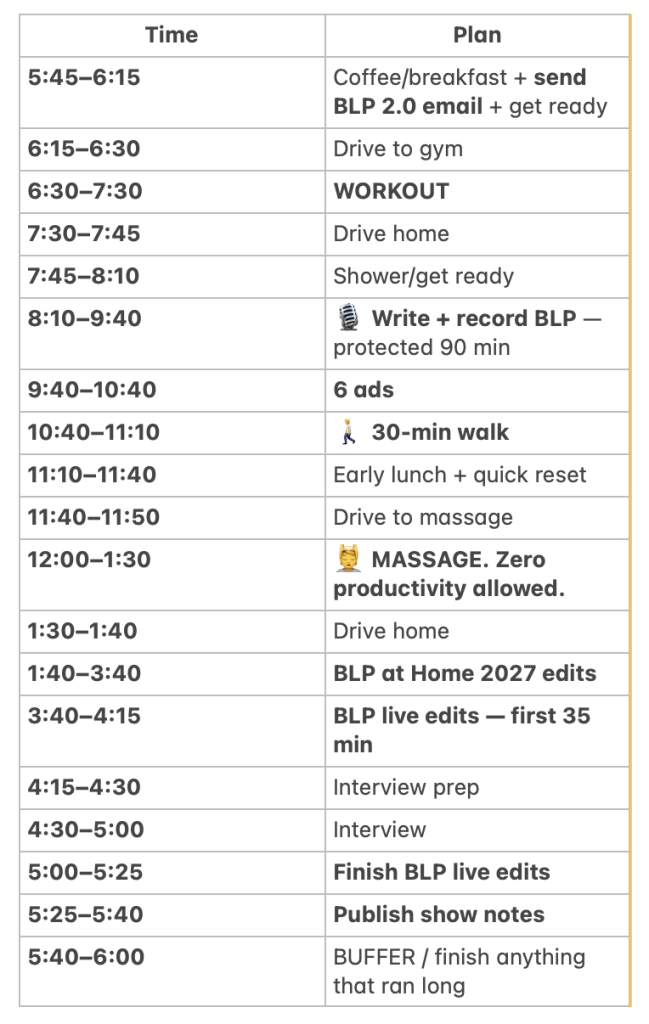
(unlike everything else here. and yes, I got a massage! I feel slightly ridiculous admitting it here but I got a ton of work done, too!)
Another side note: I did not end up following this template exactly, but I was pretty close!
Slippery slope: Accountability, venting. I admit I do this sometimes. I am the type of person who can feel accountability towards a paper list, so it’s not a huge surprise that a lifelike chatbot can have an effect. I have mixed feelings about these use cases, so I’m not recommending or condoning them, really. But figured I’d be honest!
What do I intend to NEVER use it for?
- generating creative content. Zero words from this website have been AI generated. Zero words from my podcast have been AI generated. Zero emails from me to listeners (or anyone) have been AI generated. Zero words from my newsletters are AI generated. In this week’s podcast ep, Cal Newport referred to using AI-generated content and passing it off as one’s own as dishonest and emotionally bankrupt, and I agree. HARD NEVER, everyone.
(I also hire a human designer for all of my graphics — the same one I’ve been working with for years — and I love her work. I know the AI graphics are everywhere but they won’t be in my workbooks!)
- determining the course of my life, or even creating a list of actions to complete in a given day. This is tricky! Because I LOVED having a schedule to follow today, and I just said I used it to help pick my piano selections. But I think the difference here is that I asked it to come up with ideas for piano pieces at a certain level; I didn’t ask it for ideas to fill my Tuesday nights and then it came up with “hey, how about learning some Bach inventions?”.
DO I FEAR an AI-driven apocalypse? Sort of. I also have climate concerns, economic concerns, concerns of every flavor, really. But I do not feel that my use of ChatGPT is going to cause or prevent the engine that is AI from moving forward, so my feeling right now is that I might as well use it thoughtfully where it makes sense.
(This might make me a terrible person, but I hope not!)
Note: I primarily use ChatGPT. I have played with Claude a little bit. I have never used an agent and I am not entirely sure I want to, but it is not a hard no like content creation/writing.

34 Comments
Thank you for being vulnerable and sharing your views. I second the trip planning with AI- just did this recently with our latest vacation and it helped me a ton.
“But I do not feel that my use of ChatGPT is going to cause or prevent the engine that is AI from moving forward, so my feeling right now is that I might as well use it thoughtfully where it makes sense.” This exactly. I couldn’t have said it better!
Love this! I need to similarly set my intentions. One thing that can motivate people to use AI thoughtfully is the impact to their own (and others’) natural resources and communities.
I am probably going to be in the minority here when I say I do not use AI at all. I have never used any LLM personally, outside of being-the-scenes use of AI in Google searches and such. I am required to use our closed AI platform at work. I got flagged for not using it this spring so now that I know they track usage, I use it occasionally for searches and such. It is terribly clumsy and not easy to use at all. The first time I used it to try to compare our mutual fund to another similar mutual fund, the results mistakenly compared the competitor to another mutual fund with a similar name. I had provided the 5 character ticker for the mutual funds so I was shocked that it got it so very wrong. So now I have a very low level of trust for our internal AI.
I can see the benefits of AI, like the note taking functionality that nearly all of my medical providers use. In my job, there are so few applications because most of my job is communication-based, so client calls, zooms, responding to questions from sales people, etc. I know our portfolio managers and research analysts use it a lot and I understand that application. I am very cranky about the extreme emphasis at work on using it, though. There’s a senior manager that I don’t talk with much but when I see him in a group setting, he wants to know how we are using AI and it gives me a major ick feeling, even though I highly respect this individual.
I can see us using AI to plan an itinerary for our anniversary trip to Yosemite. But beyond that, there aren’t a lot of reasons for me to use AI. My frustration is that it optimizes for efficiency – but sometimes things are gained by doing the work yourself. But our world seems to be trying to minimize friction and optimize for efficiency and I am trying to buck that trend a bit, I guess you could say.
I especially have concerns as a parent of young kids. Last week at the pool, I was discussing AI with another mom and my 8 yo chimed in and said he was worried that AI was going to do something very bad sometime. So I know kids must be talking about it because he’s never been exposed to any news stories or media content about it. 🙁
Sorry for the rant – I want to close by saying I don’t judge others for using AI! I know I am swimming upstream with my view on it!
All of this makes sense! No apologies needed whatsoever. I am definitely aware of the temptation to eliminate friction and how that can be a slippery slope.
“But our world seems to be trying to minimize friction and optimize for efficiency and I am trying to buck that trend a bit, I guess you could say.” Love this! I feel the exact same way and have also never personally used AI.
I am not sure why the use of AI should have to equate to being a terrible person! This is going to be a big part of our children’s future especially in the workplace so it is best to take part and get comfortable with it on some scale.
I haven’t used AI for trip planning much at all (ironic), but I feel like it’s something I will lean into more in the future? I really like reading about real people adventuring, so tend to visit travel bloggers posts. While it’s not the most efficient way of doing things, I really enjoy it and feel like getting something churned out by ChatGPT wouldn’t be as fun for me.
The main thing I use AI for is editing. I’ve definitely also used it to help me craft a few very… emotionally sensitive/complicated e-mails. I will admit it was INCREDIBLY helpful.
My husband has to use AI extensively in his work now (like, every single day) which is crazy because a year or two ago it was a non- thing.
Fun fact: while I reference the business my husband and I co-own quite a bit, we also had a second one (doesn’t exist any more because it was part of an aqui-hire), BUT the second business was all about machine learning in the context of agriculture. For example, sending drones up to survey farmer’s fields and then running that data through algorithms that could differentiate specific weeds/crop pests for targeted treatment to reduce environmental impacts. That was A DECADE AGO when the whole AI thing seemed so futuristic.
so interesting about the company! The hope is that perhaps we could use AI to SOLVE the environmental crisis . . . that would be best case scenario!!!
I tried to use ChatGPT to find a restaurant in Chicago that had happy hour and also allowed teenagers, and it completely hallucinated a restaurant that actually exists… but is located in Montana. I also asked it about activities in Martha’s Vineyard, and it hallucinated a Thorne Swift Nature Preserve there, when actually there is only one Thorne Swift Nature Preserve, and it is located in Harbor Springs, MI (I’ve been — it is lovely). I have found the ChatGPT itineraries helpful-ish in that they will tell you common places people have visited, but I actually find Reddit more helpful for reviews of hotels and restaurants. For instance, ChatGPT recommended The Gwen in Chicago, and it was… a little dumpy for the money we paid (I paid considerably less for a much nicer hotel in San Diego the year prior), and the water went out twice during a 4 day stay which I have never had happen at hotel I’ve stayed at… ever before.
I really like AI for editing. It can smooth out your prose or consolidate a bunch of bullet points to a lovely readable paragraph. I also had it make data tables for a manuscript recently, and had it summarize the data into verbiage. It helped me write a limitations section, and gave me a starting point-abstract of a full manuscript I wrote, but it is NOT going to be able to frame your introduction or discussion appropriately.
As far as images are concerned, I’ve been really happy with the images it generated on simple statistical / study design points for a lecture that I am giving in September. I do not need to reinvent the wheel with a de novo figure illustrating effect modification, for instance. I did ask for content for some slides… but it was heavily edited after the fact. I find that for presentations it produces a starting point and helps me overcome the activation energy of producing a whole presentation from scratch, but the content I generate after the fact is MUCH better than what it could ever do.
Oh! I did find ChatGPT did pretty well with book recommendations for me. And I continue to LOVE it for professional email correspondence. I don’t think you should feel bad about using it for the things you’ve described. I think of it kind of like Ozempic — something people will publicly shame a person for using because it’s “cheating,” but then they will shame people for being “fat, lazy, and unproductive” too. So, people use it and pretend everything just came to them naturally through hard work. There are probably more parallels, but I will stop there.
I agree wholeheartedly with the academic uses described here and in Coree’s response below – these are very similar to how I use AI at work (research faculty at a major academic medical center). I resisted use for a long time (fear of new things) but am glad to dipped my toe in. It does make me crazy, though, when I spend a LONG TIME reviewing a paper and giving thoughtful comments to an author…only to read another reviewer’s response and know with 100% certainty that it was AI-generated. Not cool!
I also found it very helpful for trip planning this summer when we were in the Netherlands. My older son was on a soccer trip with my husband while my younger son + my parents were staying about an hour away from them doing our own thing for the week. But we did want to catch one soccer game! So I plugged in the soccer schedule and game locations (copy/pasted an Excel table), our Airbnb location, and other travel constraints (relying on public transport, had to account for a 7 year old and two 77 year olds). AI suggested which game would make the most sense – down to how we should structure our day (leave in the morning, sightsee in the afternoon before the game, where to consider for dinner), which buses to take and when they would arrive, considerations that Uber may not operate in that small town and so we should check Bolt or local taxi if we wanted to get back more quickly, etc. It was SO USEFUL and saved me literally hours…which are precious in my current state of life =)
I just can’t believe all the stuff you accomplished AFTER your massage. I’m a limp noodle after I get one and wouldn’t be productive at all.
ha! I was pretty amped up and ready to work after (I think bc I already knew it was ‘the plan’). It could have been nice to do the massage later BUT the therapist I love only works early in the day! I think her last slot is like 1:30.
This is really interesting. I feel like our job expectations have expanded so enormously – and this is one way of coping. I I’m an academic and hate, hate, hate seeing wholly AI generated writing but also, this tool exists and can provide useful feedback on structure, referencing, grammar. I show my students how to use it (if they want to, entirely optional) in ways consistent with our integrity policy.
I use it in teaching prep as well – mostly for time saving. I’ve often taught similar subjects across different contexts. It’s really good at taking 3 slide decks, combining them into a logical structure, and identifying where I need to add. It’s also great at drafting a scenario for students to respond to. We can’t use it for marking, which makes sense, but I’m thinking about making a feedback tool to help make marking easier. So I’d not be uploading student work of course, but could just type short-keys for the most common feedback, and it would fill them in, and then I could customise as necessary. More to save my fingers than anything else.
I had an interview recently and didn’t want to get someone to prep for me – so I had it generate questions and voice noted my response for evaluation. It worked really well in the absence of a real life person. I submitted something recently that was about a very specific UK phenomenon but for a more general audience and I used a prompt to localise it “Pretend you were a reader from a non-parliamentary system, what aspects of this article require further definition to support your understanding”.
At a basic level, I really like the AI plugins for emails – it is so nice to say “Generate a calendar entry for this event” and it does it for you. But it’s not solved my personal email management problem.
OK, here’s my favorite use of AI. I don’t know about you but my kids’ schools send these super long pdf newsletters that I never read. If you open them in Chrome, Gemini will summarize the pdf into a list of bullet points. It’s easy to read. From there you can ask it to add key dates or tasks to your google calendar/to do list. I love it sooo much. I end up with some duplicate events but that’s way better than missing them entirely.
Also I use it a lot at work for things like:
– Coding shortcuts (like taking a list of products and adding commas so I can submit it in SQL)
– Summarizing stream of consciousness meeting notes into something useful
– Formatting an already-written email more nicely
You definitely have to keep an eye on it and edit out a lot of the weird AI things like excessive use of icons and places where it tries to get too fancy (like taking some data and extrapolating it a bit too far).
Yesssssssssss– I do this too.
How have I never thought of using it for the school newsletters?! I feel like you might have given me a solid chunk of time back haha, thanks!
We are highly encouraged to use AI at work and I am so conflicted about it. Yes, it can streamline things here and there, but you really need to know what you’re doing and be thoughtful about your prompts. I feel like the main culprit is that people just use it willynilly without any formal guidance (whatever that should look like). I think you have a very thoughtful approach and I completely agree that it shouldn’t be used for content creation/writing/design… there’s value in having HUMANS do that work (for themselves and for others!). I hate all the AI generated designs that have been popping up EVERYWHERE.
Love this! I would be interested in what prompts you used to create the schedule. My issue with AI is that I don’t seem to use the correct prompts (or word them correctly)
here’s my prompt: “I have a ton to do today and am curious to see if you could help put together a realistic schedule to get it all done! Tasks include: 1) 6 ads (will take about an hour); 2) write/record BLP (90 min); 3) send out an email to BLP 2.0 (10 min); 4) prep BLP at home edits for 2027 (2 hours?); review BLP live edits (1 hr); publish show notes when ep live (15 min, already prepped). I also am planning an hour workout likely at 6:30 AM plus driving back and forth to gym (15 min each). ALSO! I have a 90 min massage at 12p (YAY) that is 10 min away, and an interview at 4:30 which will take about 30 min and require 15 min of prep. CAN I ACTUALLY DO ALL THIS TODAY? oh and a 30 min walk break in there somewhere too. i want to finish everything by 6p”. not exactly a wark of art – but it worked quite well in this case!
Awesome! Thank you
I absolutely use AI (specifically a custom GPT which is called Project in Claude) to edit not all but a respectable percentage of emails/work messenger messages.
I have adjusted it to be the right amount of nice, not too effusive but professional and with English being my second or third language ( never sure whether to count these in the order in which I learned them or by which is getting most use daily).
I have zero regrets for using AI to make my words clearer for others, whether they are themselves native English speakers or not
I’m definitely a fan of AI. As for the environmental aspect, from what I’ve read, producing one cotton shirt or one serving of beef takes way more energy and water than all the queries any of us will ever write in a single day. Plus it’s not just AI that uses data centers, it’s every single giant company and efficiencies there would probably make the biggest difference in environmental impact.
I use it a lot for what Cal Newport calls “white boarding”. I know he thinks that we should only ideate with other humans, but I don’t have anyone in my life with a limitless capacity to “talk” about things that interest me. Thinking through options during vacation planning is one example. I do think it’s best in situations where the user has at least basic general knowledge because you have to be prepared for it to be wrong sometimes. To me, it’s like an intern who will do limitless scut work and doesn’t mind being corrected.
I do have an agent that dose some course management for me using GitHub. Not writing course material so much (though I will have it do consistency checks) but writing scripts that manage the way material flows from the source document to student-facing documents, which on some level I could have done but was waaaayyyy easier with AI help.
I wish I could turn of all the auto AI tools in Google, etc so I could just use it when I need it as I’m concerned about environmental impact and I want my usage to be intentional. I do use it at work. I’m constantly asking myself if the task I’m doing is the best use of my talents, and could I deploy AI to do this task. It wrote me a great macro in excel that took a menial task off my plate. I try to limit it to (a) admin type tasks and (b) tasks that would not otherwise get done (like spending lots of time on graphics for presentations). I use it rarely in my personal life.
It’s helpful to hear how others are using it. I mostly use it as a research assistant. It has helped me cut through a lot of Google’s noise and find obscure sites that I might not have found otherwise. Also, it helps with general genealogy research.
I also use it for helping me improve my writing. I ask it to give me five areas where my piece (usually a blog post) is inconsistent, needs to be balanced better, is lacking flow, etc. I don’t ask it to fix it, just to point it out. Super helpful to get that external feedback. While I’d love to have a human editor for my personal writing like I do at work, it isn’t feasible so CoPilot has worked well for me.
Anyway, thanks for bringing up the topic and I agree that all of my words on my site and newsletter and book are 100% human made. Writing is thinking, and I don’t want to give up thinking so I don’t plan to give up writing for myself.
Human first is the thrust of the AI literacy module our libraries designed for first year students, and I love that frame. They are very touchy about the brain storm language because they want students to know that AI does not think; it predicts. I’m a fan of this frame, too. Like you, I use it mainly as a really efficient internet search or Wikipedia repository. Like, I want to know WHAT IS KNOWN about topic X. It’s a think-then-prompt relationship for me.
Like someone else commented above, I wish I could turn off the AI summaries in Google. I don’t trust them! During the World Cup, I was looking up future games and the summary told me the “results” of a game that was about to start. 🙄
I’m a teacher and the main places I use it are: 1. to support administrative tasks that are very compliance based and that I don’t feel at all affect my students’ learning but need to be done (and increase every year). 2. I’m fairly fluent in Spanish but my writing isn’t great so I sometimes write a text I’m sending to a parent and then run it through ChatGPT (without identifying details) for feedback. I like doing that vs. Google Translate because I can ask it *why* one version is better than another. 3. For tasks when I’m fairly certain the person on the other end is going to put my response into AI to generate their own response, which makes me not want to put much effort in (this often overlaps with point 1).
I use it to help me organize things. I have used it in lesson planning, and also in planning out my garden beds! It has helped me with things I have always struggled with — structuring things, timing things correctly, etc. So now I know what to plant in which 4×4 garden bed (and why), and how to structure a lesson for the class I teach. It’s been hugely helpful in that respect. It has also helped me with meal planning, giving me ideas for lunches to pack, etc. These are not things that come easily to me at all so being able to outsource some of my brain power there is great. AI is genuinely better at it than I am, even if I’m thinking really hard!
I haven’t used it for trip planning or anything like that — not sure I would trust its recommendations. But if it tells me to plant lettuce under the trellis my peas are growing up, and that doesn’t work, well, the stakes are so much lower. 🙂
(Also — I use Claude, which is way less sycophantic than ChatGPT. I prefer its tone.)
seems super thoughtful!
Interesting on Claude. Maybe I want my AI to be sycophantic, ha!!! I get enough pushback in the rest of my life . . .
Inspired by your example I asked ChatGPT to make some sample planner layouts for the Hobonichi Cousin and Weeks based on the things and metrics I wanted to track. That was quite fun to play around with and gave me some good ideas!
For work I’m not allowed to use AI yet (I write legislation for the government), but I do fear that large parts of my job will be taken over by AI in the near future. It’s also the first technological change where I don’t really feel on top of things.
love the initial use case (an unexpected combo – CGPT + Hobonichi- but YES it works!). And I get it. Even with my positively toned post, I still have a lot of uncertainty and weird feelings about it all.
I use it all: ChatGPT, Claude and Gemini. As a public school teacher it saves me so much time with revision of syllabi, scanning for redundancies and yes even with emails. English is my third language so sometimes my emails to parents need work so I can ask for proof-reading so that I don’t have to bother colleagues/administrators.
Also for idea generation for lessons.
In my personally life… travel planning, searches, but also I’ve had it analyze my investments and retirement.
I’m a technical content writer by trade, and personal blogger at night. I’ve been using AI a lot, developing tools that help us to review our own work and ensure we adhere to our style guide for consistency etc.
That said, I refuse to let AI write my content for me, especially my blog. I feel like I’d be losing a part of my identity. I do use it for reviewing my posts, highlighting errors and typos, and recently have started using it to create my featured images for my posts. The AI creates a banner with the post name and some doodles based on the content. I’m still unsure on how I feel about the AI banner yet, possibly because of a recent experience I had.
I finally decided to stop following a blog that I’d been reading for the better part of a year. I knew they were using AI for their banners, I didn’t mind since it was cute and clearly based on what the post was about. But once I started seeing the patterns of AI writing within the post itself, I couldn’t unsee it. The word structures, the paragraph breaks, the em dashes…I found that every time I read the post I wondered how much of this was real. What was their words, versus AI? Add to that the writer never responded to comments, and I started to really get turned off. I lost the human connection, and I was out.
I feel like as long as we don’t let AI replace our identity, that we still connect as humans, and that we still show our genuine selves (warts and all) I feel like it has its place somewhere. I spent time setting up a voice profile for myself based on how I write, so that when it does review my posts, it suggests corrections that are still true to me.
Phew, and this has been a novel. How to tell it’s not AI writing this – I’m not very concise!
Agree!!!! I have zero interest in reading a blog written by a non-human. Just feels like it defeats the entire purpose . . .