- CALL WEEK IS UNDERWAY. I had a busy but good day yesterday — I got to work with a super sweet resident AND we got the kind of consult I *love* in a teaching situation at the perfect time. It was a very full day but I was able to wrap everything up nicely by the end AND I got to sleep last night! So far, so good. As of this writing, call week is over 17% complete 🙂 (And really the weekends ARE a bit easier, in part because I can sleep in if needed.)
- I HAVE TO SAY I LOVE USING OpenEvidence (an AI tool that integrates research). Despite the tech curmudgeon/skeptic that I am, I will admit that from my perspective it provides a true clinical benefit, and I feel it shines in the inpatient setting when you are teasing out cause and effect in medically complex patients on multiple medications. It’s just an incredibly tool for applying research-based information to specific clinical scenarios. I do feel you need the right background of medical knowledge to use it properly.
- MY DAD IS MAKING PROGRESS. Will keep the specifics out of it, but definitely good to see at least some things moving in a positive direction! I am checking in every day. And I’m very happy I already had a trip planned to go back in under 2 weeks.
- MY WINDSHIELD CRACKED AND IT’S OKAY. A rock hit my windshield on the highway on the way back from the airport and there is a sizable crack. Thankfully I learned that a) my car insurance covers this and b) the technician will come to your house (for free!). There will be a little bit of logistics pain because the arrival window is 8-12 but our nanny is going to help out and I will Uber/Lyft to work while things are repaired. Much less than the headache I envisioned of having to leave my car in a shop.
- I GOT ANOTHER CREDIT CARD! Points and Miles game continues — I just signed up for an AA Executive Advantage card because of the lounge benefits (well, and the signup bonus didn’t hurt either, though 70,000 points is not the world’s best for this one). Since we have our Hawaii trip coming up with a 6 hour layover in LAX it seemed like a smart idea, and this card gives immediate family members access as well, so great for family trips. We tend to fly mostly AA and sometimes Alaska which also allows for lounge access, so yay. I’ve never set foot in an airport lounge in my life but I think it will be a nice option for upcoming travel. Not sure I will keep this card long term ($595 annual fee, though SOME credits offset that) but we’ll see how it goes for the next year.
- SARAH J IS IN THIS WEEK’S BOBW! As you can imagine, it was a delightful one to record 🙂
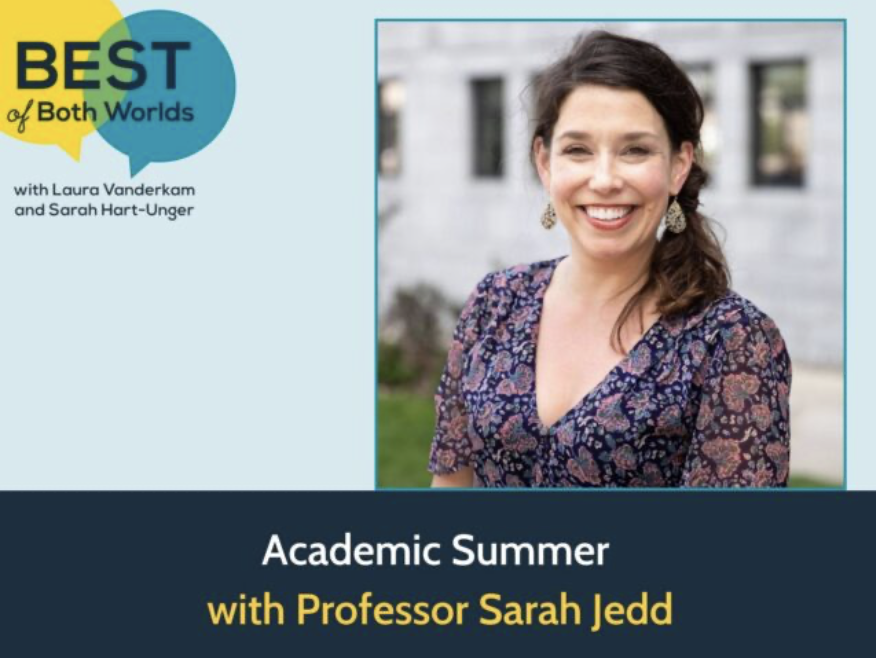
(I feel like Academic Summer should be trademarked or something!)

22 Comments
Very much enjoyed the Sarah Jedd conversation–it was one of my favorite BOBW episodes as of late and felt like a guest (relatable and interesting) and conversation (authentic) that was just right for the podcast. Keep more of those coming!
yay thank you Liz!!
So glad you dad is on the mend. Also I LOVE OpenEvidence! Sure you have to be careful to check the citations etc. but it really is amazing for helping generate differentials and usually it pulls good sources. Plus there is very little lag between publication and when that new publication is incorporated into responses.
100% percent on the AA lounge access. My husband had to join for business reasons, but we as a family are completely spoiled by the benefit. My 18 year old son had to fly to a basketball tournament a few years ago with the team and he said, “what will I do without the admiral’s club”? I was initially intimidated by the price, but I can never go back. So worth it if you can afford it.
Open evidence has been really helpful, and I do like using it, but it biases various source of information equally (old similar to new) and doesn’t have access to some things that are recent enough to be behind a paywall. And… occasionally it’s just wrong. For instance it told me that you shouldn’t use succinylcholine in patients with cerebral palsy (false) and that patients with cerebral palsy required malignant hyperthermia precautions (also false). I had another patient with a rare genetic condition that it also gave false guidelines for. Also the gynecologists recently told me that OE is recommending vaginal hysterectomy as the “standard of care” when in fact most training programs have moved to laparoscopic hysterectomy because it’s technically easier to perform and now equivalent in outcomes to vag hyst. This is a problem because patients come in wanting one procedure and don’t trust their dr when the dr offers them a different one. So… buyer beware.
Good points! This is why particularly for high stakes things I take its own text with a grain of salt and go to the references. And there’s so much nuance that could be missed (your hyst example – interesting + kinda scary!). I do worry about bias being inserted (I imagine all this tech is expensive, so what if a drug company “sponsored” it and all the sudden we see more nudges to use that drug? NOT happening to my knowledge but would be a scary possibility). And I do think it takes a pretty high level of savvy to use well. But I’m still glad it’s out there!
I had a situation where I was handing off a patient to a colleague recently and she asked me, “Well, what are you doing about MH precautions?” I said, “She doesn’t need MH precautions. Did OpenEvidence tell you that?”(it had) She then heavily insinuated that I was being reckless. I have no idea if she insisted on this when she took over care, but I could imagine real harm happening in both this and the succinylcholine scenario. She was wrong, period. Don’t be her. 🙂
On the other side of the coin, I did find it useful in researching my own various medical issues last year, and have uncovered several instances of my own doctors overlooking important things… such as the recommendation that every woman without a contraindication that has her ovaries removed who is under 51 should be given HRT… or that mosaicism in blood not present in fibroblasts is very much most likely CHIP and not germline.
I’m more worried about intentional manipulation by the government (or any government) trying to push some agenda, such as the currently popular idea in some circles that birth control is bad for you and the push to get women to have more babies. On the positive side, this sort of propaganda has been pretty obvious (to me, at least) when it has appeared in my social media feed this past year. Hopefully incompetence will prevail and it will remain that way.
I definitely had to google MH precautions …
Haha! Hashtag nicheanesthesiathings.
Glad to hear good news about your dad. My good friend is a pharmacist, and she talks about using OpenEvidence a lot in her work as well.
Oh my goodness, I listen to your podcast every week but I haven’t listened to BOBW since Lisa was on there! So I will go and download this RIGHT THIS SECOND (I don’t mean to imply anything negative about BOBW, I guess I’ve just neglected it! Will rectify this immediately)
aww I think you will love this one! Sarah is the best!!
I’ve used Open Evidence a few times, but I think you have to have a) a strong medical fund of knowledge b) willingness to check sources and invest that time outside of spitting out what the chatbot says and c) a decent BS detector.
I had a few instances it was helpful-one was about PSA testing and how to approach in a not fully in the guidelines scenario. Found a NEJM article that answered my question and was able to send the patient to Urology with better diags ordered. The other was when my preceptor recalled a clinical trial on a certain drug in patients with HIV. It took a bit of hunting through the sources, but she ended up finding the study to help my question (drug drug interactions and kidney function). It saved us time with the initial search, but some of the refs for both cases were flat out and bafflingly wrong.
VERY much agree you need medical knowledge and appropriate skepticism to use it properly (and it’s true, because of that it could also almost be a negative in the wrong hands). But with those things, it’s pretty awesome. I like it for weird drug reactions (finding case reports I might not have found on pubmed), putting together disparate features to find more rare diagnoses, and even double checking doses (faster/more complete than the data that would come up previously through UpToDate).
Im curious if you use an AI scribe. One of the clinics I go to uses it and it’s both a miracle and also kinda dumb and needs a tight leash.
Open evidence is solid but sadly also needs a tight leash. Hopefully it’ll continue to improve
nope- we have DAX and I have not been using it. I’ve seen the notes and I am not impressed. I would honestly rather type my own stuff than edit a poorly written note, and I tend to be pretty efficient w my notes anyway (do a lot of pre-noting).
(this is not to say i wouldn’t use a tool like that some day if it worked better and eliminated CLICKS! Ours just eliminates the need to type out HPI, assessment, plan etc – please give me a tool that reduces clicks effectively and I will be over the moon!)
Totally agree w death by a million clicks. I want that day to come.
Im a psychiatrist working with primarily folks that are not linear and its been helpful enough for new evals. When I’m done with an eval its such a chore to write the note. Follow ups are way easier. But now that I’ve had a patient follow up after their initial visit/AI note– it is annoying to read it and I wish it was one of “my” notes. But not enough to write the next evals note myself. But yeah, if I had a different patient population or specialty i can see it not being worth it.
So glad to hear you had a good week and that your dad’s situation is improving. I am also glad you are able to see him again in a short while. It’s so hard to be far away from family on a regular day, but especially when something is happening!
I think you hit the nail on the head: AI tools can be super-useful IF you have the background knowledge to “interpret”and assess whatever it spits out. It’s a fine line.
I listened to Sarah’s podcast ep on our train ride to the airport and it was so fun!!!!
Yes! I listened to BOBW with Sarah and it was super fun. She talks just the way I would imagine, from reading her blog.
Glad you dad is making progress! That’s good news. And glad you’re going back in two weeks.
We’re all cheering you on through your call week!
so interesting to hear your thoughts on openevidence and see the other comments! i’m a medical librarian and incorporating AI into our teaching and interactions with students has been so challenging. med students are using AI (open evidence specifically), but they don’t always have the depth of medical knowledge yet to appraise and apply the answers that the AI tool spits out. how is this changing medical education and the way future physicians are taught to think, diagnosis, etc.? as with all things AI, we’re all learning as we go. and, to complicate things, open evidence is not fully accessible to all since you have to have a NPI – this excludes librarians, non-clinical faculty, administrators, and others without the medical credentials so only a specific population can be teaching students how to use this one particular tool that seems to be everywhere these days. interesting times!!